Showing posts with label Disney. Show all posts

Tuesday, April 21, 2026

Pegbar Profile: Bob Wickersham (Sneak Peek)


For the better part of his life—about a half-century—Robert (Bob) Wickersham carried a multifaceted portfolio throughout his professional career: newspaper cartoonist, animator, storyman, director, comic book penciller, and maker of animated TV commercials. 

Robert Lysle Wickersham was born on August 5, 1911, in Colima, Mexico, to Gordon Vail Wickersham (1875-1949) and Louise Catherine Levy (1880-1954).1 When Bob was two years old, his family boarded the steamship Newport in Mexico and landed in San Francisco on December 27, 1913. By 1918, the family had moved to Ventura County, where Bob’s father worked as the manager of the Hueneme Wharf Warehouse Company.2 The family settled in Los Angeles by 1920—Bob lived with his older sister, Elizabeth Louise, and his uncle, Carlos Levy.3

In the spring of 1923, The Los Angeles Times inaugurated “The Junior Times,” a Sunday supplement where teens could submit their artwork, writing, and poetry to the newspaper.4 Its editor, under the pseudonym “Aunt Dolly,” founded the Times Junior Club, which became a springboard for several young artists soon to enter the animation business (Bob Clampett and Freddy Moore among them). At age twelve, Bob’s sketches were submitted and published by the Times. Wickersham’s talents soon paid off when he received a $10 first prize for one of his cartoons.5 As membership grew, the Times Junior cartoonists created their own selection of weekly comic strips. Wickersham began a recurring feature in 1926 with a humanized dog character, Fido Bark. 

Fido Bark's debut strip in the Junior Times, May 9, 1926.
 

The local press noticed Wickersham’s cartooning when the Oxnard Press-Courier reported on April 2, 1927, “Though young, [Bob] is remarkably clever with the pencil, and since being in Los Angeles, has attained quite a reputation with his drawings.” In 1928, Bob—nicknamed “Wicky” by his Times peers—was elected vice-president of the Times Junior Club.6 He continued cartooning at Polytechnic High, illustrating for the school newspaper, The Poly Optimist, with his classmate and fellow Club member, Isadore “Izzy” Ellis (later a chief animator for Bob Clampett). The following year, Bob became assistant editor of the Optimist

As a Poly student, Bob joined other extracurriculars like the track team and glee club (a local newspaper called him “an all-round athlete, and a mighty good singer to boot.”)7 He also served as president of the publicity board, the Scholarship Society, and, for one term, as a finance board representative. (Photo, above left, from the Junior Times, dated Sept. 12, 1926.)

By late summer 1930, Bob entered the field of animated sound cartoons when producer Charles Mintz, who struck a distribution deal with Columbia Pictures, hired Wickersham at $25 a week.8 The building, located on North Western Avenue, had a pool hall in the lobby; the Mintz operation was on the second floor. It housed two animator/director units: Ben Harrison and Manny Gould, with a series of Krazy Kat cartoons, and the trio of Dick Huemer, Sid Marcus, and Arthur Davis, who migrated from Max and Dave Fleischer’s New York studio. The Huemer-Marcus-Davis triad created Toby the Pup, a Mickey-type protagonist, for Mintz to release through RKO. Bob was brought into the “Toby” unit as Dick Huemer’s assistant. When Toby retired after twelve cartoons in 1931, the threesome developed a series with a little round-headed boy named Scrappy.

Within six months, Bob acclimated to animation production and took time to help beginners. In one instance, he taught a young hire named Carl Urbano how to draw in-betweens.9 Dick Huemer counseled his young assistants as they ascended to become qualified animators. Dick offloaded scenes for them to animate on their own. While their subordinates toiled away, Huemer and the other top animators went downstairs to the pool hall below.10 Carl Urbano remembered in a 1977 interview that Huemer “developed a good assistant like Bob Wickersham who could draw very well, could work, and was a good animator, so Dick Huemer was glad to leave him every bit that he could.”11 Wickersham continued as an animator at Mintz for the next two years. 

By March 1933, the American economy had bottomed out in the worst days of the Great Depression. While many animation factories offered artists paying jobs in the Depression’s darkest period, producers slashed their salaries to stay afloat. The Mintz studio was no exception. When each of the five major animator/directors—Ben Harrison, Manny Gould, Dick Huemer, Sid Marcus, and Art Davis—learned about Mintz's budget cuts, the group marched out to negotiate with Columbia. Mintz then quickly promoted his pool of assistants to permanent animators. This may have included Bob Wickersham. Meanwhile, the negotiations between the deserting artists and Columbia were unsuccessful. Dick Huemer left Mintz and, one month later, was hired by Walt Disney. Shortly after these events, Bob withdrew from Mintz and took a job at Ub Iwerks’ studio.12 His stay at Iwerks lasted only a few months before Wickersham moved to the Disney Studio (seen below left) near the end of 1933.13

At first, Bob was assigned small bits of animation for shorts featuring the iconic Mickey Mouse. David Hand, one of Walt’s top directors, assigned Bob to extended introductory scenes on numerous Silly Symphonies, which used new characters in almost every cartoon. This allowed Wickersham to handle pivotal sequences that defined a character's personality: the titular character in The Flying Mouse (1934) and his determined (but failed) attempts at flight as he tests makeshift wings out of leaves; Ambrose the kitten playacting as a highwayman with his toys, and his indignation when he’s summoned by his mother to take his bath in The Robber Kitten (1935); and the trio of abandoned kittens who enter a house for warmth and shelter, and later, their antics in a nursery in Three Orphan Kittens (1935).14

The animation historian Michael Barrier provided a detailed memo in which Walt gave “constructive criticism” on the skills of thirteen animators, dated June 1, 1935. Disney’s analysis of Bob Wickersham’s work was used as an example. 

“It has been observed that you lack an understanding of the proper portrayal of gags. The development of showmanship is a valuable thing and plays a great part in one’s analytical ability. Your sense of timing is limited and needs to be developed. Likewise, your resourcefulness in handling a personality has need of improvement. There is an approaching danger of a laxity in the general systematic handling of your work.  Be sure to watch for every opportunity of making your drawings foolproof, from the assistant’s and inbetween’s standpoint. Don’t lose sight of the fact that confusion at any point in a scene’s progress, be it on your board or the assistant’s or the inkers, makes for loss of time and an increase in animation cost.”15

By 1936, Dave Hand and another director, Wilfred Jackson, had supplied Bob with more ambitious sequences. For Elmer Elephant, directed by Jackson, Bob’s animation set up the dilemma of its titular character: a gang of children teases poor Elmer for his long nose as they form a parade beside him with ad hoc elephant trunks. In Three Blind Mouseketeers, directed by Hand, Wickersham animated every scene of its eponymous heroes in the first half, when they introduce themselves in song and their evasion of Captain Katt’s many deadly traps.16 Bob seemed to improve his animation, as if he had heeded Walt’s advice; his key poses became broader, which strengthened the pathos and comedy in both respective films. Meanwhile, the studio paired Bob with a young assistant named Jack Bradbury.17 The two coordinated on one of Mickey Mouse’s true classics. 

In Thru the Mirror (1936), directed by Dave Hand, Bob was assigned to work on the entire opening set-up and finale, which lasts 208 feet—over two minutes of screen time—in the final film. Inspired by Lewis Carroll’s Alice novels, Mickey’s “dream self” rises from his slumber and passes through a mirror, where he enters a strange, illogical world. Later, the Mouse eats a walnut offered by a nutcracker, who keeps only the shells, which causes Mickey’s body to shrink. The tiny Mouse then engages in a pointless conversation with a desk stand (or “candlestick”) telephone, which lets Mickey use the phone cord as a jump rope to “skip it.” For its ending, Bob animated an additional 80 feet (nearly one minute): Mickey flees the King of Hearts’ army of playing cards; his body regains its normal size as he escapes. The Mouse’s “dream self” dives back through the mirror and returns to his sleeping body.18

Animation veteran Mark Mayerson, in his critical essays of Thru the Mirror, specifically highlighted Bob’s work: “Wickersham knew how to draw appealing poses. His drawings don't have the same strong rhythm as Fred Moore’s, but the proportions are very pleasing, and the poses are well-balanced. Wickersham's Mickey is also extremely flexible, and he has a functioning brain. If you keep your eye on Mickey during these opening scenes, you see that Mickey reacts to everything that happens to him in a variety of subtle ways.”19

Next, Bob tackled another long continuity of scenes for Dave Hand. In nearly three minutes of screen time, Wickersham’s animation in Little Hiawatha (1937) takes the viewer along as the diminutive warrior paddles upstream in his birch canoe on his venture out into the forest: Hiawatha slips and falls into the water just as he touches land, which sends the woodland creatures into taunting laughter; the little hunter sneaks into the forest with his trusty bow and arrow and chases the animals without success; then, Hiawatha tracks and corners a grasshopper, which spits in his face. These scenes also establish the cartoon’s running gag: when Hiawatha readies his weapon, his pants fall down—exposing his bare buttocks to the audience—and he pauses to lift them up. (Bob’s work concludes when Hiawatha chases after a little rabbit up a tree stump.)20

For The Old Mill (1937), a landmark Silly Symphony directed by Wilfred Jackson and Graham Heid, each character animator assumed different “roles” in the film. Bob animated every scene of the owl that sleeps in the mill—again, with Jack Bradbury’s assistance.21 Graham Heid entrusted Bob with a larger sequence in Wynken, Blynken, and Nod (1938), in which the three children reel in luminous “star-fish” with candy canes, and their struggle to capture a single obstinate star-fish that lands on their shoe-boat.22 Bob worked on more Disney shorts, contributing only small chunks of animation, such as Lonesome Ghosts (1937), Mickey’s Parrot (1938), Polar Trappers (1938), and Donald’s Golf Game (1938). 

From there, Bob Wickersham worked on the Studio’s first feature-length project, Snow White and the Seven Dwarfs. In the final film, Bob received no screen credit since he contributed only 28 feet of animation—18 seconds—found in Sequence 4D (“Spooks”). Bob also worked on a 16-foot scene of Happy sewing in Sequence 11B (“Bed Building”), a section ultimately deleted from the picture.23    

In January 1938, a few weeks after Snow White held its grand premiere, production moved forward on The Sorcerer’s Apprentice, a “comeback” vehicle for Mickey Mouse (originally planned as a short before its inclusion as a segment in Fantasia). James Algar, the director of Sorcerer, handed out scenes for animation after Leopold Stokowski’s recording of Paul Dukas’ score was approved. As one of its key animators, Bob animated the scenes of Mickey’s attempts to bail a deluge of water, tossed in bucketfuls by a massive army of brooms, which then submerges the Mouse underwater. Wickersham handled a scene that occurs moments later when Mickey, atop the Sorcerer’s book of spells, gets swept along by a current.24

Bob left the Disney Studio during mid-production on Sorcerer, and his scenes were reassigned to other animators. Milt Schaffer, a fellow Disney animator who worked alongside Wickersham back at Mintz, suggested Bob’s departure was brought about by a palpable restlessness.

[Bob] was very volatile, apt to be upset, high-strung, and very nervous… He was very good while he was there, but he was just driven to make more money, accomplish more, and do all kinds of things. He was a kind of person that jumped around a lot, so when he figured there was nothing more at Disney's for him, and then I think Walt got down on it too, because he was pressing for money, and they thought, “Well, you should be interested in art and not the money. We'll give you the money, but don't worry about it. Get that animation.” That was the thing. So he left there.25

A compilation of scenes/sequences animated by Bob Wickersham during his time at Disney.

On June 12, 1938, Al Eugster, an associate of Bob’s from Mintz and Disney, wrote in his journal: “We visited the Wickershams in Westwood. Bob now working for Ub Iwerks.”26 

By the time Wickersham returned to Iwerks, Ub had withdrawn the business relationship with his distributor, Pat Powers, and rebranded his Beverly Hills studio as Cartoon Films, Ltd. Under his new corporation, Ub subcontracted several Color Rhapsodies for Charles Mintz, while development ensued on a series of twenty-four color cartoons starring “Gran’pop,” a ginger-haired ape popularized on postcards and several appearances on Collier’s magazine by illustrator Lawson Wood (1878-1957). By December 1938, production on the series had ceased, with only four “Gran’pop” cartoons completed.27 Later, Cartoon Films, Ltd. concentrated on one-minute theatrical animated commercials (”playlets”) sponsored by Kellogg’s, Shell Oil, Lever Brothers, and Kraft Cheese, among other clients, without Ub’s involvement.

Bob’s second stint at Iwerks marks an enigmatic period in his career. Paul Fennell, who assumed Ub’s managerial role at Cartoon Films, Ltd., recalled in an interview that Bob Wickersham worked on the Gran’pop films.28 The 1939 Van Nuys city directory lists Bob’s occupation as a “motion picture director,” which may suggest a directorial position at Iwerks, but no further evidence has surfaced.29 (As of this writing, it’s difficult to ascertain Wickersham’s involvement in the subcontracted Color Rhapsodies or the animated commercials by Cartoon Films Ltd. with factual accuracy.)

Meanwhile, in December 1939, Max and Dave Fleischer released their first animated feature, Gulliver's Travels, from their new state-of-the-art facilities in Miami, Florida. With Gulliver completed and plans for Max and Dave’s second feature in early developmental stages, production shifted back to shorts. The Fleischer brothers offered higher salaries than the West Coast studios and all-inclusive transportation, which attracted an influx of Hollywood cartoon writers and animators. On January 21, 1940, Bob arrived in Miami and took up residency in Coral Gables.30 As he stepped inside Fleischer’s large Miami operation, Bob was selected to animate in a unit led by two former Disney cohorts, head animator/director James (Shamus) Culhane, and top animator Al Eugster. (Sketches at left courtesy of Tim Walker.)    

Their valuable Disney credentials spurred a drive for quality, since many of the New York animators had no prior experience outside Max and Dave Fleischer’s Manhattan studio. Culhane’s West Coast contingent gave lectures on the crucial principles of drawing and animation to the other units. In one instance, on February 27, 1940, Bob and Al Eugster were guest speakers at an in-betweening class taught by venerable animator Grim Natwick, another Disney transfer.31

Throughout 1940, the Fleischer crew plunged into story work on their second feature and a year’s slate of short subjects. Max and Dave needed more outside animators to alleviate the intensive workload. During the studio’s vacation period, Bob traveled back to California to enlist more artists, one of whom was Jack Bradbury. “[Bob] called me one day, inviting me to have lunch with him,” said Jack in his autobiography. “ ‘Wick’ [Jack’s nickname for Bob] was offering me more money and a chance to animate down there, but the idea of packing up and moving clear to Florida didn't appeal to me at all.32

Wickersham pulled double duty during his stretch at Fleischer’s: he fluctuated between his animation duties for Culhane and a capacity in the story department. Bob wrote three cartoons for a new series that headlined Gabby, the excitable town crier from Gulliver and a receptacle for frustration comedy: Swing Cleaning, All’s Well, and It’s a Hap-Hap-Happy Day (all released in 1941, the last two titles derived from songs featured in the movie). Wickersham wrote other shorts, such as the “Animated Antic” Copy Cat (1941) and Vitamin Hay (1941), the final entry in Fleischer’s Color Classics—its stars, Hunky and Spunky, a mother burro and her son, earned Max and Dave an Oscar nomination three years earlier.

Bob returned to animated features as a character animator and one of several writers (credited for “screen adaptation”) on the studio’s next full-length production, Mr. Bug Goes to Town. Shamus Culhane’s unit assumed responsibility for Mr. Bug’s opening sequence, which introduced the viewer to the low-lying environs of the insect community and their perpetual danger from the towering “human ones.” The Culhane group also established the character relationships and emotional depth from its main cast: Hoppity the grasshopper, his sweetheart Honey Bee, her father Mr. Bumble, the repulsive C. Bagley Beetle, and his two lackeys, Swat the Fly and Smack the Mosquito. 

Rare pencil tests from Culhane’s sequence survive in fragmentary form, which verifies the work of Bob Wickersham and the other animators, whereas Bob’s story contributions in Mr. Bug remain unknown. Bob’s animation appears in a few personality scenes with secondary characters, like the grouchy, fatalistic snail Mr. Creeper, who watches the home of Mrs. Ladybug set ablaze—by a human’s discarded lit match—with the others (he spouts, ”We’re doomed t’ go, and don’t ferget I told ya so!”) Wickersham also animated Hoppity’s exchange moments later with Buzz, a little bee Scout, inside Mr. Bumble’s Honey Shop.33

Bob Wickersham's animation in Mr. Bug Goes to Town

As work continued to ramp up on Mr. Bug, Frank Tashlin—a former Disney writer—recommended Bob for an available slot at Screen Gems, Columbia Pictures’ continuation of the old Mintz studio. On April 4, 1941, Bob attended a farewell luncheon, where he enjoyed the company of Culhane, Eugster, and other Fleischer members before his trip back to the West Coast animation landscape.34

This ends the first chapter of Bob Wickersham's career - more to come in a future printed edition (release date to be determined).

Special acknowledgments to Michael Barrier, J. B. Kaufman, David Gerstein, Hans Perk, Mark Mayerson, Frank M. Young, and Strummer Cash Petersen for their contributions to this post.

 ________

[1] Civil registration birth records in Colima, Mexico list Robert as Gordón Roberto Lysle Weckershan”; the 1920 Los Angeles Census lists him as “Robert G. Wickersham”; his 1932 marriage certificate as “Robert Thomas Wickersham” (his birth year is listed 1910); otherwise, Robert is listed as “Robert L.” in the 1937 Van Nuys city directory; listed as “Robert L. Wickersham” in the 1940 Coral Gables and Los Angeles censuses; and as “Robert Lysle Wickersham” on his 1940 draft registration card. Courtesy: Ancestry.

[2] California, U.S., Arriving Passenger and Crew Lists, 1882-1959. Courtesy: Ancestry.

[3] 1920 United States Federal Census, Los Angeles. Courtesy: Ancestry.

[4] The Los Angeles Times, Apr. 29, 1923. "The Junior Times," p. 6.

[5] Oxnard Press-Courier, July 29, 1925, p. 3. Bob’s cash prize amounts to $187 in 2026 US currency. 

[6] The Los Angeles Times, Apr. 3, 1927. "The Junior Times," p. 3.

[7] The Los Angeles Times, Mar. 4, 1928. "The Junior Times," p. 1.

[8] Variety, Aug. 27, 1930. p. 247. Bob’s weekly pay amounts to $489 in 2026 US dollars. 

[9] Milt Schaffer, interview with Milt Gray, Mar. 21, 1977. Unpublished. Carl Urbano, interview with Milt Gray, Dec. 19, 1977. Unpublished.

[10] Carl Urbano, interview with Michael Barrier, February 8, 1997. Extracted from Michael Barrier, Hollywood Cartoons: American Animation in its Golden Age (2003, paperback edition), p. 172.

[11] Urbano interview, 1977. 

[12] While the exact date Wickersham left Mintz is unclear, it might have occurred sometime between April and May 1933. Huemer went on the Disney payroll on April 16, and Al Eugster claimed that he left Mintz in May 1933 to work for Ub. Both Eugster and Irv Spence corroborated Wickersham’s presence at Iwerks’ studio (they each were staffers during the same period). Al Eugster, interview with Michael Barrier, Mar. 17, 1978. Unpublished. Irv Spence, interview with Milt Gray, Nov. 29, 1976. Unpublished.

[13] Disney studio records hold no information regarding Wickersham’s exact start of employment. Bob’s earliest known assignment was for the Silly Symphony, The Night Before Christmas; production papers credit him on the toy band. The pencil animation for Christmas ensued between October 6 and November 16, 1933, providing an estimated timeline for Wickersham’s official hiring. JB Kaufman and Russell Merritt, Walt Disney’s Silly Symphonies: A Companion to the Classic Cartoon Series (2016, hardback edition), p. 138.

[14] Kaufman/Merritt, Walt Disney’s Silly Symphonies: A Companion to the Classic Cartoon Series (2016, hardback edition), pp. 147, 158, and 168.

[15] Michael Barrier, The Animated Man: A Life of Walt Disney (University of California Press, 2007), pp. 112-113.

[16] Kaufman/Merritt, Walt Disney’s Silly Symphonies: A Companion to the Classic Cartoon Series (2016, hardback edition), pp. 175 and 180.

[17] “Excerpts from Jack Bradbury’s Autobiography.” https://jbrad.org/autobiog.html

[18] Hans Perk, A Film L.A. “Prod. UM-41 - Through the Looking Glass,” final production draft, dated March 6, 1936. Published May 24, 2006. https://afilmla.blogspot.com/2006/05/prod-um41-through-looking-glass.html

[19] Mark Mayerson, “Thru the Mirror, Part 4.” Mayerson on Animation, published Feb. 10, 2008. https://mayersononanimation.blogspot.com/2008/02/thru-mirror-part-4.html

[20] Kaufman/Merritt, Walt Disney’s Silly Symphonies: A Companion to the Classic Cartoon Series (2016, hardback edition), p. 190.

[21] Ibid, p. 193. Jack Bradbury, interview with Milt Gray, March 23, 1977. Unpublished.

[22] Ibid, p. 196.

[23] Hans Perk, A Film L.A. “Prod. 2001 - Snow White & the Seven Dwarfs (VII).” Published Oct 26, 2009. https://afilmla.blogspot.com/2009/10/prod2001-snow-white-seven-dwarfs-vii.html  “Prod. 2001 - Snow White & the Seven Dwarfs (XIX).” Published Nov. 9, 2009. https://afilmla.blogspot.com/2009/11/prod2001-snow-white-seven-dwarfsxix.html

[24] JB Kaufman, Worlds to Conquer: The Art and Making of Walt Disney’s Fantasia (Insight Editions, 2025), pp. 85, 87, and 285.

[25] Milt Schaffer, interview with Milt Gray, Mar. 21, 1977. Unpublished.

[26] Mark Mayerson. “Al Eugster’s Journal, The Disney Years: 1935-1939.” Reprinted in Walt’s People: Talking Disney with the Artists Who Knew Him, vol. 28 (Skyway Press, 2023), p. 29.

[27] The Film Daily, Dec. 19, 1938, p. 7, mentions that three “Gran’pop” cartoons were completed. The three titles were A Busy Day, Beauty Shoppe, and Baby Checkers. Period-era trade magazines allude to a fourth Gran’pop cartoon, Monkey’s Business, without a determined release date. (The Exhibitor, Feb. 15, 1939, survisection 6. Showmen’s Trade Review, Apr. 8, 1939, p. 31.) The first three Gran’pop cartoons were released theatrically in 1940 through Monogram Pictures. Meanwhile, Ideal Pictures Corporation sold non-theatrical Cinecolor prints concurrently with their theatrical exhibition. 

[28] Paul Fennell, interview with Milt Gray, December 7, 1977. Unpublished.

[29] Van Nuys, California, City Directory, 1939, p. 145. Courtesy: Ancestry. 

[30] Mark Mayerson. “Al Eugster’s Journal, The Second Fleischer Period: 1939-1942.” Unpublished. 

[31] Ibid. 

[32] Bradbury autobiography. https://jbrad.org/autobiog.html

[33] The extant test reel sampled Bob’s scenes of Mr. Creeper (sc. 19, dated April 28, 1941), and Buzz, the bee scout (scs. 55 and 57, dated January 6 and 7, 1941). As it’s presented, Wickersham’s pencil animation went into “clean-up” before the drawings were transferred to ink and paint. Courtesy: Jane Fleischer Reid. 

[34] Mark Mayerson, “Al Eugster’s Journal, The Second Fleischer Period: 1939-1942.” Unpublished.

Saturday, October 26, 2024

The Animator, January 1938


The second issue of The Animator is missing as of this writing, so here is the third edition from the start of January 1938. Snow White had its Carthay Circle premiere and would have its general release the following month.

The Animator provided an avenue for sharing industry news with Guild members, outside of the usual trade journals such as Variety, The Film Daily, et. al., chiefly Ub Iwerks’s upcoming series of “Gran’Pop Monkey” cartoons based on the illustrations by Lawson Wood. Contrary to what the newsletter persists, twenty-four cartoons - not fifty - were planned, but according to The Film Daily, only three were completed by the end of 1938, with no more produced. 


The newsletter also proudly declares its objective: “The Screen Cartoon Guild is the only bonafide organization representing all of the studios in the animated cartoon industry.”

Though she is unnamed in the newsletter, the home address of Schlesinger employee/Guild secretary Charlotte Darling, appears again at the bottom of the document. 

Courtesy of Mark Kausler. 

_______

 
Now, here’s issue number 4, from January 21, 1938. 

“Looney Tunes” in color? Charles McKimson joins MGM! New model sheets for Scrappy! By then, the Screen Cartoon Guild’s membership expanded, mainly from artists at Walter Lantz.


As you'll see on the left hand column, the writer heavily criticizes the anti-union organization The Neutral Thousands (initialized as TNT), established in 1937, and Harman-Ising's "sudden and inconvenient" shutdowns, which laid off many of its artists. 
 
In their “Exposure Sheet” column, the Guild newsletter offers exclusive tidbits otherwise undocumented in the trades, frequently providing the only clue as to one’s career path in animation. We’ve previously seen that Charles (“Chuck”), the youngest McKimson brother, started in animation as early as 1933 at Harman-Ising; now, we see that Charles joined MGM’s cartoon department (which opened months earlier in August 1937.) It is uncertain how long Charles worked at MGM and in what capacity—assistant or full animator is my educated guess. At any rate, Chuck joined Leon Schlesinger as a full-fledged animator in Tex Avery’s unit, receiving his first on-screen credit in Land of the Midnight Fun (1939).

The name “Peter Paige” escapes me, but it might be Peter Page, who became a Disney storyman by 1939. (David Gerstein and JB Kaufman, Mickey Mouse: The Ultimate History, pp. 321-322.)

The newsletter references Boy Meets Dog, Walter Lantz’s commercial film for Ipana Toothpaste, the “nationally known molar grease company” in question. Like Disney borrowed Harman-Ising’s inkers and painters for Snow White, Leon Schlesinger allowed Walter to use his ink-and-paint staff to meet the sponsored cartoon’s deadline.
 
 
Background painter John Waltz, a name brought to my attention by Steven Hartley years ago, was profiled on Tralfaz. Perhaps Waltz was hired at MGM to do background paintings, as well? 
 
As many animation fans are aware, the Looney Tunes continued in black-and-white until 1942’s The Hep Cat, directed by Bob Clampett. An original release print of the series’ color debut has not survived, more commonly seen in its 1949 “Blue Ribbon” reissue.

Lew Landsman’s departure from Schlesinger’s is worthy of note. A storyman for Schlesinger, Landsman received only one screen credit there (see left). Later, Lew returned to Leon Schlesinger’s—the studio’s internal house organ, also named The Exposure Sheet, announced his second departure in approximately February 1939. In fact, a September 1945 issue of Top Cel shares that Lew found a job at Famous Studios in New York (no occupation is specified.) 
 
For its final anecdote, the newsletter proclaims 1938 as a “banner year” for Mickey Mouse, who Donald Duck eclipsed, and Walt knew it. On January 10, 1938, renowned musical conductor Leopold Stokowski recorded an orchestration of Paul Dukas’s “The Sorcerer’s Apprentice” for a “special” Mickey Mouse comeback vehicle; its development began as early as May 1937. (Barrier, Hollywood Cartoons)  
 
 
Courtesy of CSUN Northridge Archives, Motion Picture Screen Cartoonists Guild, Local 839 Collection. Special thanks to David Sigler for providing this document.

Tuesday, September 3, 2024

Pegbar Profile: George Manuell

 
Caricature of George Manuell by T. Hee, circa 1930s.  
Image courtesy: Bonhams Auctions.
 
George Francis Manuell was born in Renton, Washington, on August 7, 1909, as the second child to John Joseph Manuell and Annie McKay; George’s father hailed from Departure Bay in British Columbia, while his mother was Scottish-born.1 George’s family, including his older brother John W., moved away from Renton to California, settling in San Joaquin County before his first birthday.2 By late 1918, the Manuells had relocated to Los Angeles.

 
1918 draft registration card of John J. Manuell, George's father.
 
George attended Garfield School in Pasadena as a teenager, as reported in The Pasadena Post.
 
The Pasadena Post, June 14, 1923.

George drew at least one known cartoon for “The Junior Times,” the Los Angeles Times’ avenue for aspiring young cartoonists—many of whom went into the animation business—published on December 13, 1925. (George's signature is shown in the second panel.)


The 1927 and 1928 Alhambra directories indicate that he worked as a laborer, though no company or business was specified.3

According to the 1930 Los Angeles Census, George took a job as a librarian for a newspaper. (The 1930 Alhambra city directory, however, lists his occupation as a clerk.)4

It is still undetermined when Manuell entered the animation business, but speculation points to approximately 1933. Al Eugster stated in a 1978 interview that George was one of the lead writers at Ub Iwerks’s studio—there, George worked on stories with Otto Englander and Ben Hardaway.
5 (George is shown seated for an Iwerks staff photo, circa 1934, on the left.)  
 
George had moved to Walt Disney’s studio as a storyman by the fall of 1934. Archival evidence unearthed by David Gerstein and JB Kaufman revealed that George helmed two story ideas that were never produced beyond early development: “Hillbilly Mickey” and “School Days”—the latter’s outline cast Mickey and the gang as unruly schoolboys!6

George married Olga Jane Winters, a stenographer for Barker Bros., on September 4, 1936.
 
 
Around 1937, George was hired at Leon Schlesinger Productions as a writer, where he received screen credit on at least five cartoons: Porky’s Double Trouble (Tashlin, 1937), Jungle Jitters (Freleng, 1938), The Isle of Pingo Pongo (Avery, 1938), Porky’s Spring Planting (Tashlin, 1938), and Wholly Smoke (Tashlin, 1938). 
 
 
George migrated to Miami to work as a writer at Max Fleischer’s new animation building, following Schlesinger storymen Tedd Pierce and Cal Howard. Among George’s story credits was a trio of Popeye cartoons where the Sailor co-starred with his ornery father Poopdeck Pappy: With Poopdeck Pappy (1940), Child Psykolojiky (1941), and Pest Pilot (1941).
 

Shortly after the release of Gulliver’s Travels, Max Fleischer made cutbacks in personnel. George was laid off from Fleischer’s on February 8, 1940.7 He returned back to Los Angeles.

The 1940 Los Angeles Census lists George’s occupation as a “cartoonist.” His draft registration card, dated October 1940, stated that he worked for The Los Angeles Times, presumably in the same capacity. (The 1942 Los Angeles city directory also lists George as a cartoonist.)8
 

George then became an aircraft worker for the war effort, as his occupation is listed here in the 1944 Arcadia city directory. 


George and his wife Olga also welcomed their daughter, Sherry Fay, on January 4, 1944.9

In March 1946, The Pasadena Independent reported that George had formed a business, Manuell Arts Advertising Agency.

Later, an August edition noted of George’s participation in the Pasadena Advertising Club. 

Pasadena Independent, Aug. 21, 1946.

By 1950, George used his artistry for Rexall Drug Store, a job he held for at least eight years.10

In 1958, George was hired as a coordinator for Lockheed Aircraft Missiles in Los Gatos.11 He passed away on October 19 that same year in Santa Clara, at age 49.

 
 __________________________________________________
 
1. George Francis Manuell, Washington, US Birth Records, 1907-1920. Courtesy: Ancestry.

2. 1910 US Federal Census, San Joaquin (Douglas Township), enumeration district no. 117, lines 91-94. 

3. 1927 Alhambra, California City Directory, p. 191. 1928 Alhambra, California City Directory, p. 196. Courtesy: Ancestry.

4. 1930 US Federal Census, Los Angeles (Alhambra), enumeration district no. 19-1412, lines 47-50. 1930 Alhambra City Directory, p. 201. Courtesy: Ancestry. 

5. Al Eugster, interview with Michael Barrier, March 17, 1978. Unpublished
.
6. David Gerstein and J. B. Kaufman, Mickey Mouse: The Ultimate History (Taschen, 2018), pp. 287-289.

7. Al Eugster’s Journal, 1939-1942. Courtesy: Mark Mayerson. Unpublished. 

8. 1940 US Federal Census, Los Angeles, enumeration district no. 60-703, lines 5358. Courtesy: Ancestry. 1942 Los Angeles City Directory. Geo. F. Manuell, US City and Business Directories, ca. 1749-1990. Courtesy: FamilySearch. 

9. Sherry Fay Manuell, California Birth Index, 1905-1995. Courtesy: FamilySearch.

10. 1950 US Federal Census, Los Angeles (Arcadia), enumeration district 19-1204, lines 22-24. Courtesy: Ancestry. 1952 Monrovia City Diretory, p. 313; 1953 Monrovia City Directory, p. 532; 1955 Arcadia City Directory, p. 483.

11. 1958 Los Gatos City Directory, p. 344.

Tuesday, April 2, 2024

Pegbar Profile: Frank Tipper

This profile is an update from an old Cartoon Research profile, published in June 2017. Here is a new and improved overview on animator Frank Tipper's career!

 
 Caricature of Frank Tipper, published in the June 20, 1931
edition of Motion Picture Herald, when he worked as an 

assistant animator for Walt Disney.

Frank George Tipper, the first child of English parents Frank Tipper and Lillian Marrion, was born on August 19, 1909, on the Isle of Man.1 The following year, Frank’s parents shared a residence in Worcester with his grandparents, George and Charlotte—Frank Sr. worked there as a taxi cab driver.2 While still in England, the Tipper family added two daughters: Lillian Margaret was born in 1913, and Joan Eileen in 1915.3 On March 23, 1921, Frank and his family emigrated to the United States. They landed in Los Angeles on April 1, having made the voyage on the S. S. Adriatic from Southampton. Frank Sr. secured a position in the States in the transportation department of the Richfield Oil Corporation.4 

The adolescent Frank first pursued an artistic career by submitting cartoons to the “Junior Times” supplement of the Los Angeles Times as early as November 1925.5 Apart from cartooning, Tipper admired the animation business; he frequented Walt Disney's studio to show Walt his new work.6 Frank graduated from Belmont High School in 1928, where he drew illustrations for Campanile, the school yearbook. Soon after Tipper left high school, his cartoons for the “Junior Times” disappeared.7 Frank then enrolled in the University of California at Los Angeles, Otis Art Institute, Chouinard Art Institute, and the Frank Wiggins Trade School.8

Frank's early work from the March 18, 1928 edition of "The Junior Times."

In 1930, Tipper lived with his parents and sisters, and worked as a sign painter for Foster & Kleiser, then touted as “the leading billboard company on the West Coast.” His youngest sister Joan remembered, “That was the only way you could make money as an artist in those days.” One day, Walt Disney arranged a screening of his cartoons at the Vista Theater at Sunset and Hillhurst and recognized Frank, now employed as an usher. Walt recalled Frank's teenage visits and offered him a job at his animation studio.9

Disney studio records have no definite date for Tipper’s official hiring. By 1931, Frank became one of three assistants to Norm Ferguson, one of Disney’s leading animators.10 Later that year, Ben Sharpsteen recruited Tipper as a junior animator; he handled scenes under Sharpsteen’s tutelage on the Mickey Mouse and Silly Symphonies cartoons. A year later, Frank shifted to Dave Hand’s crew of junior artists, where he settled during the remainder of his tenure at Disney. One production that Tipper animated, under Hand’s supervision, was Flowers and Trees, the first commercially released film in three-strip Technicolor.11 While still employed at Disney, Frank married Mary Elizabeth Dotzler in Glendale on August 8, 1932.12

Layout drawing from Bugs in Love (1932). 
Note the stamp that credits Frank Tipper for the animation.

In late 1932, Frank left Disney to work at a studio run by Ted Eshbaugh, a producer-director who experimented with color cartoons, which began with a pilot cartoon that starred a character named Goofy Goat. Filmed in the Multicolor process, “Goofy Goat” caught public attention as the first full-length animated film in colorits March 1932 release predated Disney’s Flowers and Trees by four months.13 Tipper joined the Highland Avenue studio while Eshbaugh was busy on his second Multicolor cartoon, The Snow Man; its production finished by the end of January 1933. Tipper involved himself in Eshbaugh’s The Wizard of Oz. Though it never had a theatrical release in the United States, Eshbaugh’s Oz adaptation was the first short subject filmed in three-strip Technicolor.14

Production drawing for Ted Eshbaugh's The Wizard of Oz (1933).

Eshbaugh’s studio went bankrupt after work finished on Snow Man and Oz, leaving Frank unemployed again. Tipper soon found work at Leon Schlesinger’s new animation department, founded after producer-directors Hugh Harman and Rudy Ising broke off their contract with Leon. Tipper received credit on Schlesinger’s first color cartoon, Honeymoon Hotel (1934), filmed in Cinecolor. During his time at Schlesinger’s, on November 11, 1934, Frank was involved in an auto collision with actress-dancer Joan Dix. The actress suffered headaches and dizzy spells after Tipper’s car crashed into Joan’s vehicle. (Joan filed a $7,000 lawsuit for the damages, but Tipper failed to appear for the trial months later on September 1, 1935; she won $2,725 in the settlement.)15

Production background for Honeymoon Hotel (1934), Warner Bros.' first cartoon in color.
Image courtesy: Mike and Jeanne Glad Collection.  

Opportunity called from Frank's home country. On January 8, 1935, Frank and his wife Mary landed in England, where they resided at the Regent Palace Hotel.16 Tipper worked on animated commercials, likely on sponsored films produced by early British animation artists Laurie Price and Christopher Millet.17 Frank’s stay in England was momentary—Frank and Mary returned to Los Angeles four months later, on May 17.18 Frank soon took a job at Harman-Ising; Hugh Harman and Rudy Ising now produced a color series, Happy Harmonies, for distribution by MGM. Surviving production drafts list scenes attributed to Tipper in at least three Happy Harmonies, each directed by Ising: Honeyland (1935), Alias St. Nick (1935), and The Early Bird and the Worm (1936).19 

Harman and Ising often exceeded the budgeted amount of their cartoons and violated their contract with MGM. The studio terminated its agreement with H-I in February 1937, which created chaos for the employees that year. That September, following an altercation with Metro, Harman-Ising went into a three-week shutdown and laid off a few of its animators, including Frank.20  By the end of 1937, Tipper found an open spot at Walter Lantz’s studio.

Months after Frank joined Lantz's studio, he and Mary settled into a new home on Longridge Avenue. Soon, the couple welcomed their only child, Kim, on October 13, 1938.21 At Lantz’s cartoon factory, a rowdy camaraderie amongst the young artists flowed inside and outside work activity, especially during parties and social functions, often fueled by liquor. One day after a studio Christmas party, Frank (who was, as his sister Joan described, “quite a heavy drinker”) sat at his desk with a terrible hangover and placed his eyeglasses atop his desk to take a brief rest; a practical joker swiped Frank’s spectacles and painted red and purple spots on the lenses. When the bleary-eyed Tipper awoke and put on his glasses, he shouted at the sight of these strange flecks: “Oh, my God! What’s happened to me?”22

As an independent producer who sold cartoons to Universal, Walter Lantz's was a risky business. In late 1939, Lantz's weekly advances from Universal (his primary source of capital) ended, so Walter had to fund the cartoons himself. However, Lantz could not provide the necessary finances to keep his studio functioning and closed its doors on February 24, 1940. Lantz's animators volunteered to produce an Andy Panda, Crazy House, for free. This provided Universal with the collateral to bankroll more cartoons.23 Frank received screen credit in Knock Knock (released in November 1940), the film that introduced movie audiences to the zany antics of Woody Woodpecker. Later, in December 1941, Lantz released the first in a series of "Swing Symphonies," $21 A Day (Once A Month), for which Frank also was credited. His last screen credit was on the Woody Woodpecker cartoon, The Loan Stranger (released October 1942), directed by Frank’s brother-in-law Alex Lovy.24

The United States’ involvement in World War II triggered a flurry of government films that illustrated military objectives and instructions through animation. In October 1942, Hugh Harman Productions, formed in 1941 after Harman left Metro, hired Tipper to work on a new series, "History in the Making." These animated government films, intended for release by United Artists, centered on the global battle of the United States and its allied nations in the Second World War.25 Tipper was inducted into the Army in July 1943he remained part of Harman's creative team.26 The Hollywood Reporter, in September 1943, announced a deal between the U. S. Office of Education and Hugh Harman Productions to produce a series of ship-building films. Frank was tasked with an investigative trip to the California Shipbuilding Corporation (CalShip) in San Pedro, acquiring knowledge of the details of ship construction.27

In 1945, Frank volunteered to take his craftsmanship on tour with a USO-Camp Shows troupe to the Pacific area and the Far East—he left for duty that July.28 Frank visited military bases, combat zones, and camps. There, he sketched caricatures of troops and servicemen and painted murals; he also painted portraits of patients housed in neuropsychiatric hospitals during the six-month excursion. On January 19, 1946, Frank sailed on the U. S. Heritage from Nagoya, Japan. He landed in Seattle, Washington on February 5 and verified the government work for his visa so he could retain his legal status.29 A few weeks later, he was back in Los Angeles.30 Frank and his wife Mary divorced earlier on an unspecified date; she married her second husband on January 9, 1946, a few weeks before Tipper returned home.31

Details on Frank’s professional career in the mid-1940s are fragmentary; he dabbled in comic book work for James Davis (The Fox and the Crow), who had a stable of moonlighting animators who wrote, penciled, and inked funny-animal stories for $15 a page ($239 in 2024 US currency).32 Frank signed his work on a trio of stories with humanized fish and mollusks aptly named “Fishy Follies,” each issued between April and October 1946. 

A sampling of Frank's comic book work, from Goofy Comics #14 (June 1946).

Not much is known of Tipper’s career in 1947 and 1948; we can assume he stayed busy on jobs that were unreported at the time. We next hear from him at the end of February 1949, when The Los Angeles Evening Citizen-News reported the following:

“When the Painters and Sculptors Club meets Tuesday night [March 1] at 8 at the Los Angeles Art Association galleries, Frank Tipper, formerly official cartoonist with the occupational forces in Japan, will give a talk on Japanese artists, past and present...”33

Later that fall, Frank helped break new ground in television when Filmtone Studios hired him in their commercial art and animation department.34 The Life of Riley, which first aired on NBC on October 4, 1949, was shot in Hollywood when most sitcoms in New York were broadcast live on kinescope. (The show also featured Jackie Gleason in his first TV role.) A few months later, Frank became the series’ art director.35 The network axed Riley after one seasonits final episode aired in March 1950.

A new studio in Beverly Hills, Century Television Productions, took on Frank as an art director for a television pilot starring popular Western actor Wild Bill Elliott. In mid-June 1950, its first episode “Marshall of Trail City,” was shot at Cudia City in Phoenix, but the pilot never sold.36 In August, Filmtone struck a deal with NBC to produce an upcoming program, You Bet Your Life, hosted by Groucho Marx. Frank was called in again for its art direction.37 It is unclear if Frank stayed in live-action television between 1951 and 1953. However, 1954 gave Frank a chance to work on a major motion picture.

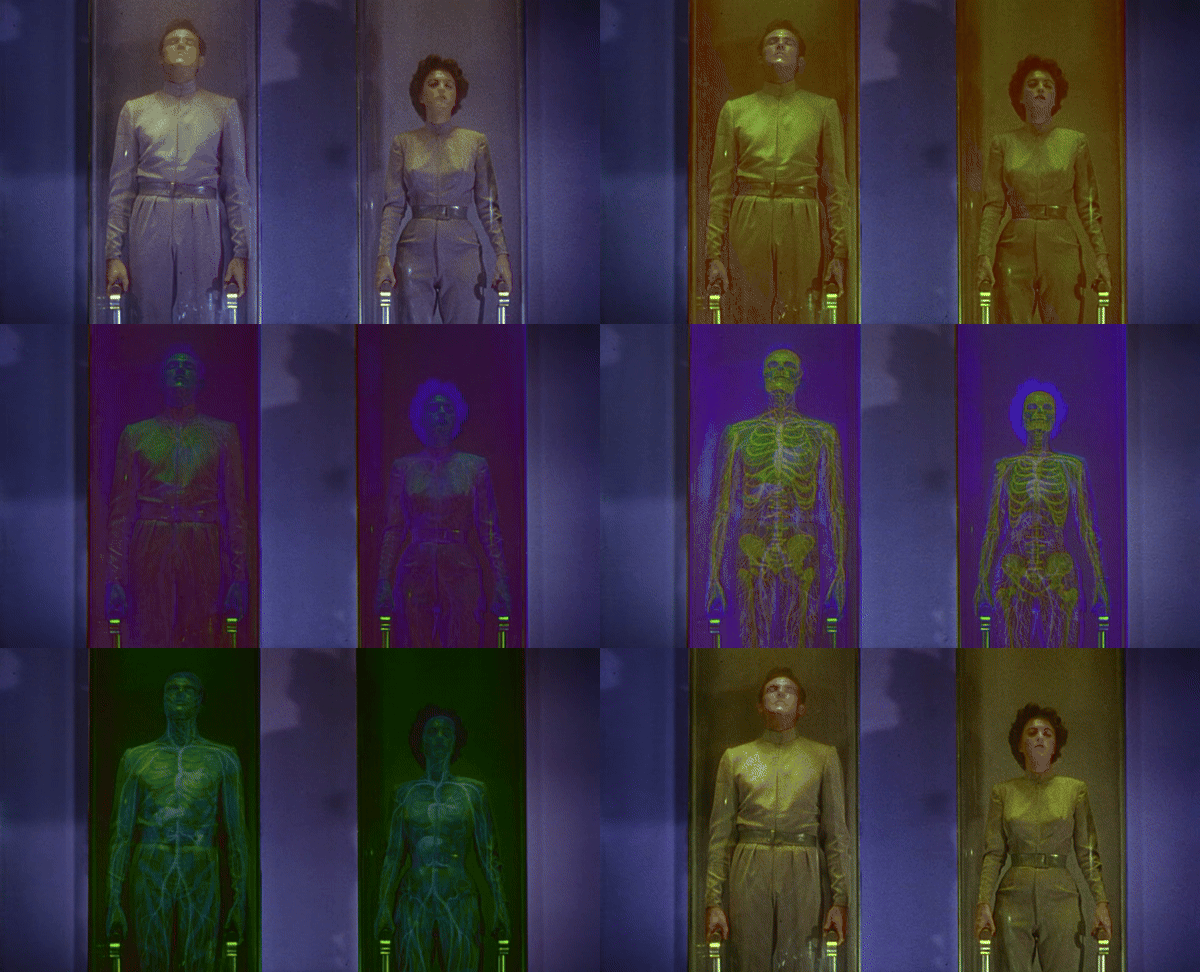
Universal-International’s elaborate Technicolor science-fiction project, This Island Earth, went through much of its principal photography in February 1954. Tipper was brought in to create special animation effects of saucer rays and neutrino rays. The most significant contribution occurred moments after its two protagonists, Cal Meacham (Rex Reason) and Ruth Adams (Faith Domergue), were abducted and taken into a spaceship by an alien species from the planet Metaluna. Moments later, the two humans are sealed in converter tubes to acclimate to the planet’s atmospheric pressure. The viewer watches as their bodies transform, and reveal the layers of their anatomical structure. Frank worked closely with the film’s effects director, David S. Horsley, to supervise the optical effects for this sequence.

John “J. J.” Johnson, author of Cheap Tricks and Class Acts: Special Effects, Makeup and Stunts from the Films of the Fantastic Fifties, described how Tipper achieved this effect:

“After photographing the conversion tubes alone, then with Reason and Domergue inside them, Tipper went to work on the individual matching dissolves. With the aid of anatomy books, Tipper made several layout drawings of muscles utilizing chalk on black cards. These were then photographed in black and white and used as mattes. Once the dissolves with differing parts of human anatomy were organized, Tipper gave them to [optical printer] Roswell Hoffman to have them colored so each dissolve would possess its own unique hue. In the final composite, when the different colored anatomy layers dissolved in and out, it gave the conversion sequence a sensational X-ray effect.”38

The matching cross dissolves, as shown in This Island Earth (U-I, 1955).

Frank (and Horsley) utilized the same technique during the disintegration of the insect-like Metaluna Mutant when it succumbs to the spacecraft’s intense pressure. This Island Earth had a matinee preview for press reviews on April 9, 1955, at the Victoria Theatre on Broadway—the film saw its general release in Los Angeles on June 15.39 This seemed to be Frank’s only foray into live-action features; Phil Monroe remembered Frank working on commercials at Cascade, one of many outfits that provided animated television ads, in approximately 1954, presumably afterhis assignment on This Island Earth.40

Meanwhile, British animation in the 1950s flourished when John Halas and Joy Batchelor’s studio in London produced Animal Farm (1954), Britain’s first color animated feature based on the allegorical novel by George Orwell. Halas & Batchelor offered Frank a position as an animation director. On January 3, 1956, he returned to England. The Daily Film Renter and Moving Picture proclaimed Frank’s “wealth of experience should certainly make its mark on the already high standards of Halas & Batchelor productions.”

Tipper took on a few sponsored films at H&B, including The Candlemaker (1956) for the United Lutheran Church and The First 99 (1958), a history of whiskey distillation sponsored by Seagram that combined live- action and animation.41 Frank served as animation director on The World of Little Ig (1957), involving a caveboy on a mythical planet. Intended for American broadcast on NBC, who funded the short, Little Ig was, instead, shown in British cinemas. The film received a first-prize award at the Venice Film Festival. Tipper planned to stay abroad in England for two years, but changed his mindhe boarded the S.S. Liberte in Southampton on April 2, 1957, and arrived in New York on the S.S. Liberty six days later.42

In the summer of 1957, Frank joined the staff of Le Ora Thompson Associates, a commercial house in Hollywood established by Leora Thompson (formerly a sales director for Playhouse Pictures) and animator Carl Urbano.43 A year later, Bill Hanna and Joe Barbera enlisted Frank at their production company for the first season of The Huckleberry Hound Shownot in their animation staff, but as a background painter. Tipper received credit on only four segments: three installments featuring Pixie and Dixie and Mr. Jinks and Pie-Pirates, the first Yogi Bear cartoon in production; presumably, Frank may have only worked at H-B as a freelancer.

In 1958, Frank secured work on more TV commercials at Swift-Chaplin Productions, run by Howard Swift, a former Disney/Screen Gems animator, and Charles F. Chaplin.) He remained at Swift-Chaplin until his passing on September 20, 1963, at 54.44

Special acknowledgments to Jerry Beck, J. B. Kaufman, Hans Perk, Michael Barrier, Mark Kausler, Eric Costello, Tom Samuels, and Frank M. Young for their contributions to this post. 

__________

(1) Frank George Tipper, California, County Marriages, 1850-1953. Courtesy: FamilySearch.

(2) Census of England and Wales, 1911, schedule no. 19, rows 1-5. Courtesy: Ancestry.

(3) Lillian May Tipper. California, U.S., Federal Naturalization Records, 1843-1999. Courtesy: Ancestry.

(4) New York, U.S., Arriving Passenger, and Crew Lists (including Castle Garden and Ellis Island), 1820-1957. Frank Sr.’s occupation is listed as a “motor mechanic.” Courtesy: Ancestry. Los Angeles Evening Citizen-News, Nov. 19, 1958, p. 17.

(5) The Los Angeles Times, “The Junior Times,” November 8, 1925, p. 6. “The Junior Times” fostered other young cartoonists who later developed their talents in animation: Bob Clampett, Fred Moore, Ed Benedict, Cal Howard, Izzy Ellis, Phil De Lara, and Manuel Moreno, among others.

(6) Joan Eileen Pabian, interview conducted by Martha Sigall, November 28, 1998. Published on March 13, 2017, on Cartoon Research: https://cartoonresearch.com/index.php/a-chat-with-joan-pabian-and-al-pabian/

(7) The August 26, 1928 publication of “The Junior Times” supplement in The Los Angeles Times is the last known mention of Tipper’s name.

(8) 1947-48 International Motion Picture Almanac, ed. Terry Ramsaye, p. 412.

(9) Pabian, 1998 interview. The 1930 Los Angeles census lists Frank’s occupation as a “commercial artist.” 1930 US Federal Census, Los Angeles, Assembly District 55, lines 91-95.

(10) Larry Silverman, interview with Milton Gray, December 3, 1977. Unpublished.

(11) Frank Tipper’s production credits originate courtesy of Hans Perk’s A. Film LA blog (http://afilmla.blogspot.com), JB Kaufman and Russell Merritt, Walt Disney’s Silly Symphonies: A Companion to the Classic Cartoon Series, and an email sent to author by Kaufman, May 18 and June 6, 2023.

(12) The Los Angeles Times, July 31, 1932. Frank’s naturalization record, date-stamped November 28, 1962, curiously lists their marriage taking place earlier on August 14, 1931. Frank George Tipper, California, County Marriages, 1850-1953. Courtesy: FamilySearch. Frank George Tipper, California, U.S., Federal Naturalization Records, 1843-1999. Courtesy: Ancestry.

(13) While Ub Iwerks’ Fiddlesticks (1930) predated Eshbaugh’s “Goofy Goat” cartoon as one of the first sound color cartoons, Flip the Frog’s screen debut was released in color only in Britain, while black-and-white prints were distributed in the United States.

(14) The Los Angeles Illustrated Daily News, Jan. 30, 1933. The Wilkes-Barre Times Leader, the Evening News, April 7, 1933. Coincidentally, former Disney junior animators Bill Mason and Andrew “Hutch” Hutchinson animated scenes in Flowers and Trees and both Eshbaugh films. JB Kaufman and Russell Merritt, Walt Disney’s Silly Symphonies: A Companion to the Classic Cartoon Series.

(15) The Los Angeles Illustrated Daily News, Sept. 2, 1935, p. 4C; The Chicago Tribune, Sept. 3, 1935, p. 6. Joan Dix appeared uncredited as a chorus girl in Warner Bros.’ 1933 musical 42nd Street (1933). She landed herself in a main role in Dwain Esper’s exploitation film Narcotic, released the same year.

(16) Frank George Tipper. UK and Ireland, Incoming Passenger Lists, 1878-1960. Courtesy: Ancestry.

(17) 1947-48 International Motion Picture Almanac, ed. Terry Ramsaye, p. 412. Details on Laurie Price and Christopher Millet’s animated commercials “Following Up on Gifford: The 1930s.” The Lost Continent: Exploring the Art and History of British Animation. August 12, 2010. https://ukanimation.blogspot.com/2010/08/following-up-on-gifford-1930s.html

(18) Frank Tipper. New York, U.S., Arriving Passenger, and Crew Lists (including Castle Garden and Ellis Island), 1820-1957. Courtesy: Ancestry.

(19) Production drafts of Honeyland, Alias St. Nick, and The Early Bird and the Worm. Courtesy: Michael Barrier.

(20) Michael Barrier, Hollywood Cartoons: American Animation in its Golden Age (2003, paperback edition), p. 603 n19. A handwritten employee sheet from Harman-Ising mentions that background painters Don Schaffer and Art Riley were loaned to Disney until November 1 (for the Silly Symphony Merbabies). Frank’s name appears on the roster, but his name is absent in a typewritten personnel record dated December 23, 1937, implying he was no longer employed at Harman-Ising. (A small, handwritten note on the December sheet reads, “Lay off all in 2nd period [of contract], which started 9-1-37 - layoff started 9-11-37.”) Courtesy: Mark Kausler.

(21) Kim Tipper. California Birth Index, 1905-1995. Courtesy: Ancestry. San Fernando Valley Times, October 20, 1938.

(22) Pabian, 1998 interview.

(23) Joe Adamson, The Walter Lantz Story, p. 111-112.

(24) Frank’s wife Mary had a sister, Florence, who was licensed to wed Alex Lovy in Yuma, Arizona, on November 1, 1940. (Florence was also the spouse of animator Carl Urbano from 1932 to 1937.) Florence Burslem. Arizona, U.S., County Marriage Records, 1865-1972. Courtesy: Ancestry.

(25) Daily Variety, Oct. 22, 1942. The Hollywood Reporter, Oct. 22, 1942.

(26) Daily Variety, July 6, 1943.

(27) The Hollywood Reporter, Sept. 13, 1943.

(28) Daily Variety, July 11, 1945. The Hollywood Reporter, Sept. 20, 1945, confirmed that Tipper was stationed in the Philippines as “a USO sketch artist.”

(29) Frank Tipper. Washington, U.S., Arriving and Departing Passenger and Crew Lists, 1882-1965. Courtesy: Ancestry.

(30) Daily Variety, Feb. 25, 1946. Alec Geiss, a Columbia/Screen Gems animation director, also traveled with Tipper on tour. 

(31) Mary E. Tipper. California, U.S., County Birth, Marriage, and Death Records, 1849-1980. Courtesy: Ancestry.

(32) “Excerpts from Jack Bradbury’s Autobiography,” The Comic Art of Jack Bradbury. http://jbrad.org/autobiog.html Every month, after the stories were fully inked, Davis then packaged and mailed the artwork from California to  Benjamin Sangor, owner of the American Comics Group (ACG), in New York.

(33) Los Angeles Evening Citizen-News, Feb. 29, 1949.

(34) The Hollywood Reporter, Sept. 8, 1949.

(35) Daily Variety, Jan. 18, 1950. Frank replaced John DeCuir on Riley, who would later earn eleven Oscar nominations for art decoration (The King and I, Cleopatra, Hello, Dolly!)

(36) The Los Angeles Times, June 16, 1950. Broadcasting Telecasting, June 26, 1950.

(37) Pabian interview, 1998. Variety, August 1950, p. 34. You Bet Your Life’s pilot episode was filmed at Hal Roach Productions, but Roach was underbid by Filmtone.

(38) John “J. J.” Johnson, Cheap Tricks and Class Acts: Special Effects, Makeup and Stunts from the Films of the Fantastic Fifties (1996, McFarland & Company, Inc.), p. 99.

(39) Tom Weaver, David Schecter, Robert J. Kiss, and Steve Kronenberg, Universal T errors, 1951-1955: Eight Classic Horror and Science Fiction Films (2017, McFarland & Company), p. 261.

(40) Phil Monroe, interview with Michael Barrier, Oct. 29, 1976, published on Barrier’s official website, June 7, 2012. <http:// www.michaelbarrier.com/Interviews/Monroe/Monroe1976.html> Monroe mentioned joining Ray Patin’s studio in 1954 after leaving Cascade.

(41) Though Halas and Batchelor both received onscreen director credit on The Candlemaker, period-era film trade stories affirm Frank’s involvement as a director. The Daily Film Renter and Moving Picture (London, England), March 27, 1956. The Hollywood Reporter, April 3, 1956.

(42) Frank’s naturalization petition, date-stamped November 28, 1962, notes the travel dates from his departure to England and return to the United States. Frank George Tipper. California, U.S., Federal Naturalization Records, 1888-1991; Frank Tipper. UK and Ireland, Outward Passenger Lists, 1890-1960; Frank G. Tipper. New York, U.S., Arriving Passenger, and Crew Lists (including Castle Garden and Ellis Island), 1820-1957. Courtesy: Ancestry.

(43) Broadcasting Telecasting, June 17, 1957. The news piece mentions Frank’s previous association with Anigraph Films, an obscure company that produced short educational films about the Social Security program. Departments of Labor and Health, Education, and Welfare and Related Agencies Appropriations for Fiscal Year 1976, pp. 2238, mentions Anigraph Films and its filmmaking objectives.

(44) Frank’s death certificate mentions Swift-Chaplin Productions as his last employing company. Frank George Tipper. California, County Birth and Death Records, 1800-1994. Courtesy: FamilySearch.